
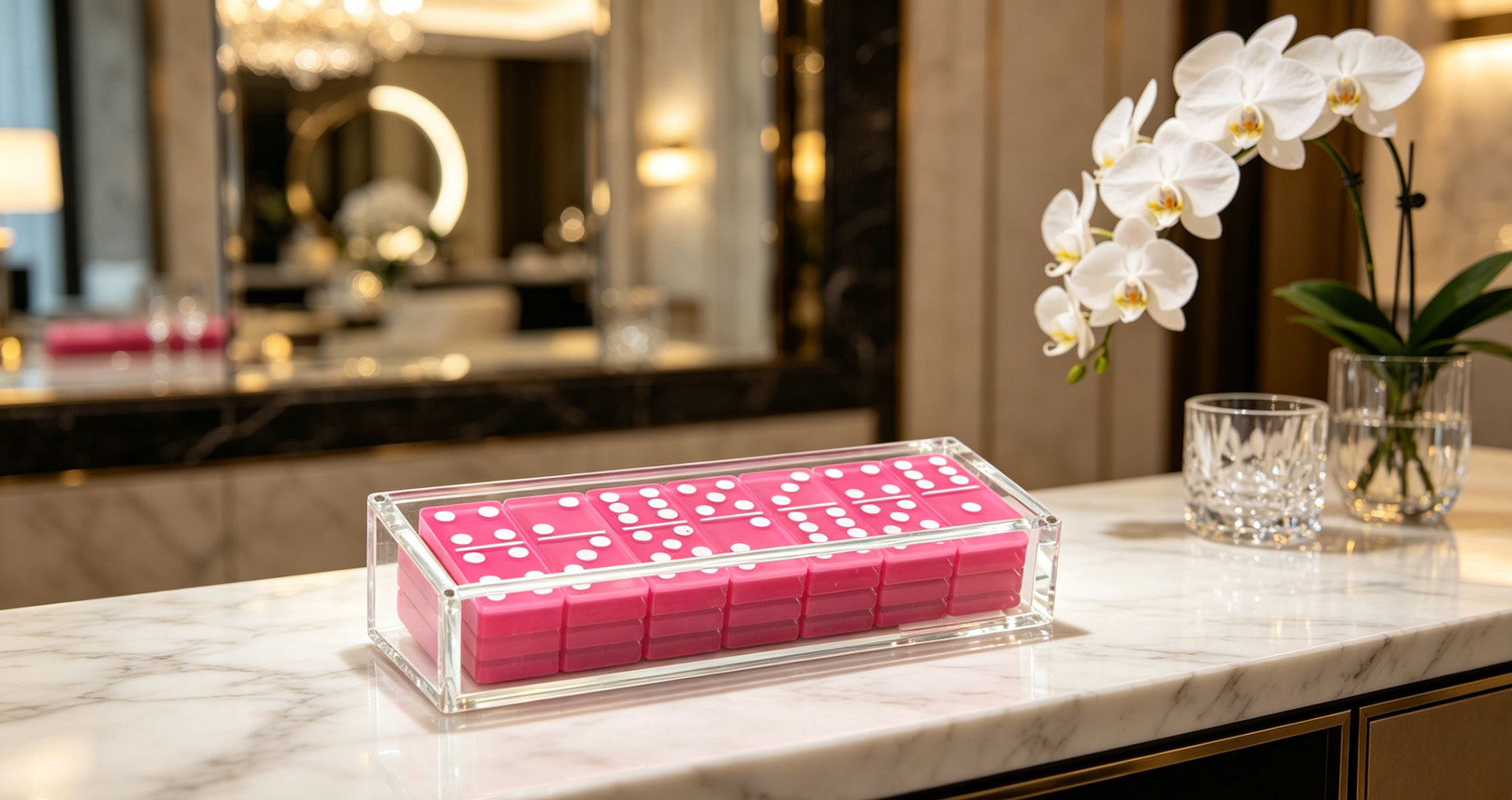
Sourcing custom acrylic domino sets for your retail line requires more than finding a supplier with competitive pricing. You need a manufacturing partner who can deliver consistent quality, handle customization at scale, and navigate the complexities of international B2B procurement.
In this guide, we walk you through the complete sourcing process—from evaluating a custom domino manufacturer to placing your first order. You'll learn how to assess factory certifications, understand MOQ structures, specify customization requirements, and negotiate terms that protect your brand. Whether you're launching a private label program or expanding your game product category, this article gives you the practical framework procurement teams use to source with confidence.
Key Points:
• A 5-step framework for evaluating and selecting acrylic domino suppliers
• Key certifications that separate legitimate manufacturers from trading companies
• How to structure customization requests for faster sampling and production
• MOQ and pricing variables that affect your per-unit cost
• Quality control checkpoints every buyer should implement before shipment
Why the Sourcing Approach Matters for Custom Acrylic Domino Sets
The acrylic domino market includes trading companies, small workshops, and established manufacturers—each offering different capability levels. Choosing based solely on unit price often leads to quality inconsistencies, missed deadlines, and communication friction that derails your product launch.
A structured sourcing approach prevents these pitfalls. By evaluating suppliers against objective criteria—certifications, production capabilities, quality control systems, and communication responsiveness—you make decisions backed by evidence rather than assumptions. This matters especially when you're committing to private label programs where brand reputation is on the line.
At JAYI Acrylic, we've worked with buyers who initially approached us skeptically about OEM acrylic domino production timelines. After walking through our certification framework and QC processes, they understood why certain lead times exist and how to plan their procurement calendars accordingly. The sourcing process isn't a hurdle—it's your quality gate.
Step 1 – Define Your Product Specification Before Approaching Suppliers
Before sending inquiry emails, document your requirements in a product specification sheet. Suppliers respond faster and more accurately when they receive structured information rather than vague descriptions like "domino set with custom logo."
Your specification sheet should cover these elements:
Product Configuration
• Domino format: Double 6 (28 tiles) or Double 9 (55 tiles)
• Tile dimensions: Standard 58mm × 29mm × 9mm or custom sizing
• Tile count per set: Number of tiles, spare tiles, and accessories
Material Requirements
• Acrylic grade: 100% virgin acrylic vs. recycled content (we recommend virgin for clarity and durability)
• Thickness tolerance: Industry standard is ±0.2mm; specify tighter tolerances if needed for premium positioning
• Surface finish: Clear, transparent, frosted, or solid color
Customization Scope
• Logo placement: Center label, tile backs, or storage box
• Printing method: Screen printing, laser engraving, UV digital printing, or hot stamping
• Color matching: Pantone color code for brand consistency
Packaging Specifications
• Inner packaging: Polybag, blister card, or velvet-lined box
• Master carton: Units per carton, carton dimensions, gross weight limit
• Retail-ready requirements: Hang tags, barcodes, care labels
Sending this specification upfront filters out suppliers who cannot meet your technical requirements and accelerates the quoting process. View our custom acrylic domino set product page for reference on the customization options we support.
Step 2 – Evaluate Supplier Credentials Beyond the Website
A professional website tells you little about actual manufacturing capability. Legitimate factories invest in certifications that verify their quality systems, social compliance, and production capacity. Here's how to evaluate credentials that matter:
Quality Management Certifications
ISO9001 certification indicates the factory operates under a documented quality management system. SGS and TUV certifications provide independent verification of product testing and factory audits. These aren't marketing claims—they require annual third-party audits to maintain.
Social Compliance Certifications
BSCI (Business Social Compliance Initiative) and SEDEX membership demonstrate that the factory meets labor and ethical standards required by major retailers. For buyers targeting Walmart, Target, or European retail chains, social compliance certification is often a procurement prerequisite.
Retailer-Specific Audits
Passing Walmart or Target supplier audits represents a higher bar than standard certifications. These audits evaluate factory infrastructure, quality control procedures, raw material sourcing, and documentation practices. JAYI has completed both Walmart and Target supplier audits—a signal that our operations meet the most rigorous retail standards in North America.
Factory Transparency Signals
• Physical address matches manufacturing registration (avoid addresses in commercial districts)
• Technical staff who can answer specification questions directly, not just sales coordinators reading from scripts
• Documentation includes QC checklists, inspection reports, and production schedules
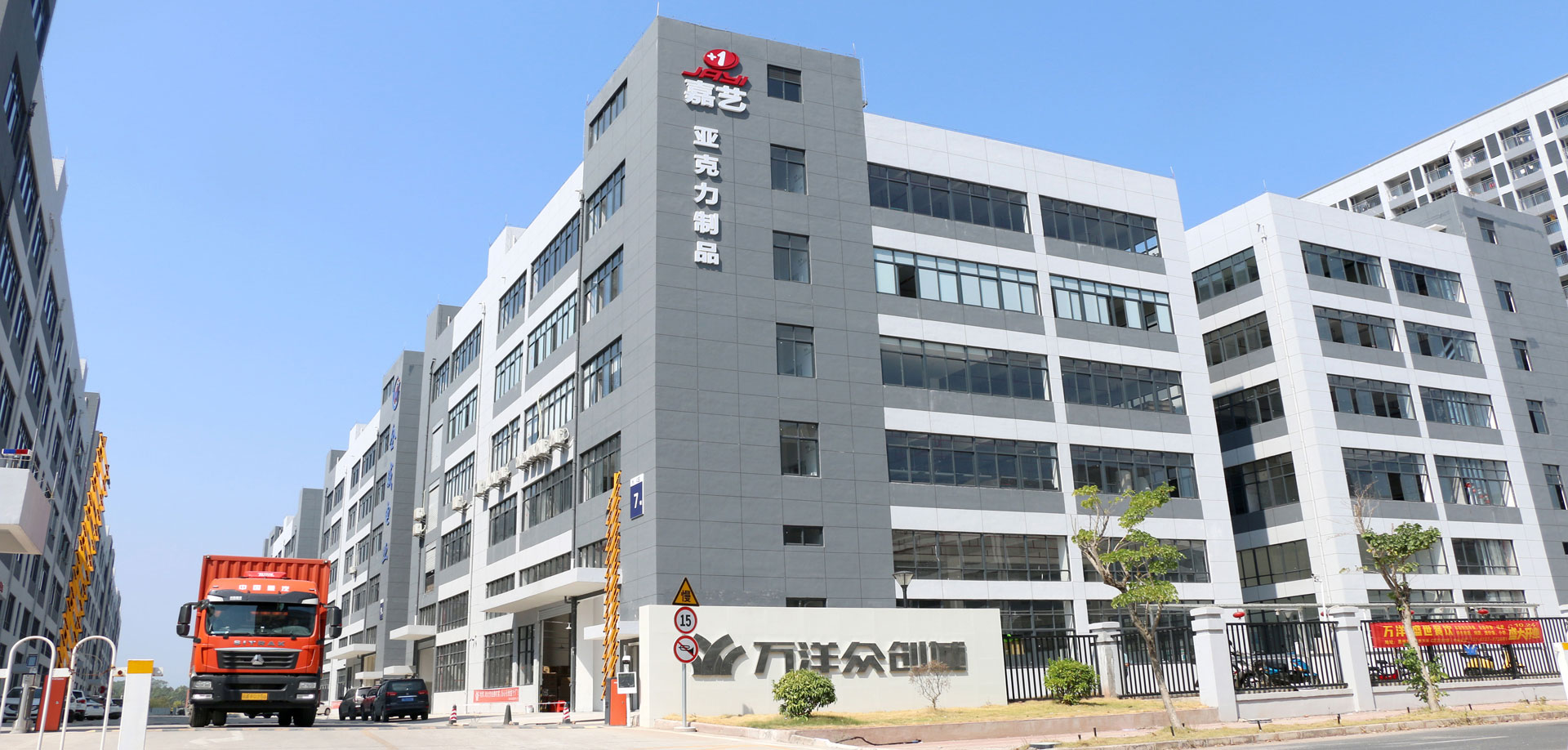
At Jayi Acrylic Industry Limited, we operate from a 10,000㎡ self-owned facility in Boluo County, Huizhou, Guangdong, China, with 150+ employees. Our certifications span ISO9001, SGS, TUV, BSCI, and SEDEX, with documented processes covering every production stage from raw material inspection to final packaging.
Step 3 – Request Samples and Validate Manufacturing Quality
Samples reveal what the supplier actually produces—not just what their marketing materials claim. The sampling phase separates confident suppliers from those avoiding quality verification.
How to Request Domino Set Samples Effectively
Request 3 to 5 samples with your exact specifications: same material, same printing, same packaging. Avoid "pre-production samples" that use simplified processes—your production run will follow a different workflow.
Specify sample quantity and budget. Some suppliers include 1 to 2 free samples in their evaluation process; others charge tooling or setup fees. Clarify costs upfront to avoid surprises.
What to Inspect in Acrylic Domino Samples
• Dimensional accuracy: Tiles should match specified dimensions within tolerance. Check with calipers—not just visual inspection.
• Surface quality: No scratches, bubbles, sink marks, or cloudiness. Under bright light, transparent acrylic should display consistent clarity with 95% light transmission.
• Printing precision: Logo registration, color accuracy against your Pantone reference, and ink adhesion. Scrape the printed surface with a fingernail—quality ink won't chip easily.
• Tile weight and feel: Premium acrylic dominoes feel solid. Lightweight tiles may indicate thin cross-sections or recycled material.
• Spindle integrity: For dominoes with metal spindles, verify secure fitting and smooth rotation.
Timeline for Sample Evaluation
Plan 3 to 7 days for sample production, plus 5 to 10 days for international shipping. Build this into your product development calendar—rushing samples often leads to overlooking defects that appear in production runs.
Step 4 – Understand MOQ Structures and Volume Pricing Logic
Minimum order quantities exist because manufacturers cannot operate profitably below certain production volumes. Understanding MOQ logic helps you negotiate terms and structure orders that make financial sense for your business.
Why MOQs Exist
Every production run incurs setup costs regardless of quantity: machine calibration, ink mixing, packaging material cutting, and quality inspection. Below a certain volume, these setup costs distributed across units produce uncompetitive pricing. MOQs ensure the supplier can deliver quality at sustainable margins.
Typical MOQ Ranges for Acrylic Domino Sets
|
Customization Level |
Typical MOQ |
Notes |
|
Standard color, no logo |
200-300 sets |
Fastest production timeline |
|
Custom logo (screen print) |
300-500 sets |
Requires film setup per color |
|
Full Pantone matching |
500-1,000 sets |
Ink mixing and approval process |
|
Custom packaging + logo |
500+ sets |
Packaging tooling may apply |
Factors Affecting Per-Unit Pricing
• Order volume: Larger orders distribute fixed setup costs across more units
• Customization complexity: Multi-color printing, Pantone matching, and specialty finishes increase unit cost
• Packaging type: Retail-ready packaging with foam inserts costs more than polybag packaging
• Tile count: Double 9 sets (55 tiles) cost more than Double 6 sets (28 tiles) due to material and labor volume
Negotiating MOQs with New Suppliers
Many manufacturers offer reduced MOQs for first orders with the expectation of larger reorders. Position your first order as a "qualification order" with the promise of repeat business at higher volumes. At JAYI, we work with buyers to structure pilot orders that let you validate quality before committing to full production runs.
Pricing varies based on specifications and volume—share your complete requirements for a tailored quote that reflects your customization scope and order timeline.
Step 5 – Finalize Customization Options and Artwork Requirements
Customization transforms standard domino sets into branded products. For OEM acrylic domino production, clarity in specifications prevents production errors that cost time and money.
Logo and Branding Customization
Screen printing handles most logo requirements for acrylic domino tiles—supporting up to 8 colors with precise registration. For photorealistic designs or gradient artwork, UV digital printing offers superior detail reproduction. Laser engraving works well for single-color text logos and produces a permanent mark that won't wear over time.
Artwork should be provided in vector format (AI, EPS, or PDF) with all fonts converted to outlines. Include a color breakdown specifying Pantone codes for each color—this ensures your brand colors match across samples and production runs.
Color Matching and Material Selection
Pantone color matching adds time and cost but ensures your brand colors translate accurately to acrylic material. Without Pantone matching, manufacturers use standard color swatches that may vary between production batches.
For transparent or frosted acrylic, color affects light transmission. Request samples in your target color to verify the visual effect matches your expectations.
Packaging and Accessories
Consider these packaging variables for retail-ready presentation:
• Storage box: Clear acrylic box, wooden box, or leather-bound case
• Interior padding: Foam inserts, velvet lining, or branded cloth
• External packaging: Branded master carton with UPC barcodes
• Accessories: Instruction cards, score pads, additional tiles
Coordinate with your supplier on packaging dimensions to ensure retail-ready specifications—shelf-ready packaging eliminates repackaging costs at your distribution center.
How JAYI Supports Large-Scale Acrylic Domino Production
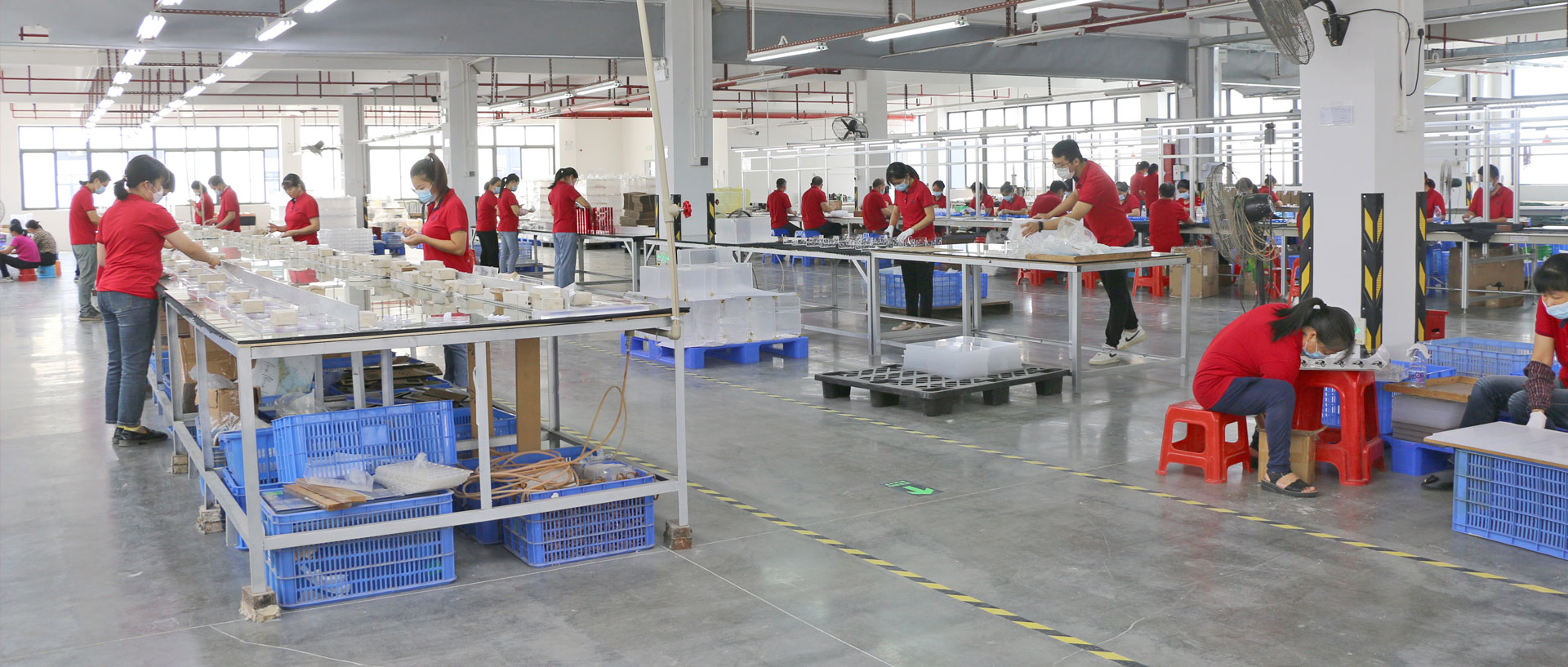
JAYI Acrylic has manufactured custom acrylic board game products for over 22 years, supporting private label programs for retailers including Walmart, Target, and Sam's Club. Our production infrastructure combines scale with precision—handling everything from initial sampling to container shipments.
Manufacturing Capabilities
Our facility houses 95+ specialized equipment units covering the complete production workflow: laser cutting, CNC precision carving, diamond-edge polishing, professional bonding, screen printing, and custom packaging. This vertically integrated approach means we control quality at every stage rather than outsourcing critical processes.
For acrylic domino production, we maintain dedicated production lines that ensure consistent tile thickness, uniform printing registration, and rigorous dimensional inspection. Our QC team performs 100% inspection before shipment—every single tile checked against your specification tolerances.
Certification-Backed Quality
Beyond ISO9001 and SGS certifications, our facility has passed Walmart and Target supplier audits, demonstrating compliance with their strict quality, safety, and operational standards. For buyers requiring documented quality systems, we provide complete audit documentation and inspection reports.
Lead Times and Production Scheduling
• Sample production: 3 to 7 business days
• Production lead time: 15 to 35 business days, depending on order complexity
• Rush options available for time-sensitive launches (surcharges apply)
If you're building an acrylic board game collection, our domino production capabilities extend to related products like custom acrylic mahjong sets—letting you consolidate suppliers for your entire game product line.
Payment and Trade Terms
We support T/T, Western Union, and Trade Assurance for secure transactions. For established buyers, we offer flexible payment terms that align with your cash flow requirements.
Frequently Asked Questions
What is the typical MOQ for custom acrylic domino sets from a manufacturer?
Minimum order quantities for custom acrylic domino sets typically range from 300 to 500 sets per order, depending on the supplier and customization complexity. At JAYI, we structure MOQs based on your specification requirements—standard color orders start at 300 sets, while fully customized orders with brand-specific Pantone matching and packaging may require higher quantities to achieve competitive unit pricing.
How long does it take to receive a sample of custom acrylic domino sets?
Sample production for custom acrylic domino sets takes 3 to 7 business days at most OEM manufacturers. The timeline depends on the complexity of your customization request—basic color samples process faster, while samples requiring Pantone-matched acrylic or custom packaging typically occupy the full 7-day window. Shipping samples internationally adds another 5 to 10 days depending on your location.
What certifications should I look for when sourcing acrylic domino manufacturers?
When sourcing acrylic domino manufacturers, prioritize suppliers holding ISO9001 for quality management systems, SGS or TUV for product testing and verification, and BSCI or SEDEX for social compliance. For retail programs targeting major retailers, verify whether the manufacturer has passed Walmart and Target supplier audits—these certifications indicate the factory meets rigorous third-party operational standards.
Can I get custom packaging and branding for my acrylic domino sets?
Yes, most acrylic domino manufacturers offer comprehensive customization, including brand logo printing via screen printing (up to 8 colors), laser engraving, or UV digital printing. Custom packaging options include branded boxes, foam inserts, velvet-lined cases, and retail-ready hang tags. Pantone color matching ensures your brand colors translate accurately across production runs.
What quality control measures should I request before shipment?
Request 100% inspection before shipment rather than spot-checking—a reliable acrylic domino manufacturer will accommodate this. Specify acceptable tolerance ranges for dimensions, weight, and surface finish. Ask for third-party inspection authorization (SGS, Bureau Veritas, or similar) if you're sourcing for premium retail channels. JAYI supports third-party inspection and provides detailed QC reports with every shipment.
How do I calculate the total cost of sourcing custom acrylic domino sets?
Total cost calculations should include unit price, tooling or setup fees (if applicable), packaging costs, inland freight to port, customs clearance, and ocean or air freight. For accurate pricing, provide your supplier with complete specifications: domino tile count (Double 6 or Double 9), tile thickness, printing method, packaging style, and target quantity. Pricing varies based on specifications and volume—share your requirements for a tailored quote.
Final Summary
This guide outlines a complete 5-step B2B sourcing workflow for custom acrylic domino sets, covering product specification confirmation, supplier credential verification, sample quality validation, MOQ and pricing analysis, and final customization confirmation.
Strictly following this standardized process helps retail buyers avoid quality risks, unreasonable costs and delivery delays.
Choosing certified, vertically integrated manufacturers like JAYIensures stable product quality, flexible order terms and professional one-stop OEM/ODM services, supporting long-term retail product line expansion and brand building.
Ready to Start Your Custom Acrylic Domino Project?
If you're ready to move from sourcing research to concrete quotes, share your product specifications and timeline with our team. We'll provide a detailed quotation within 24 hours and walk you through the sampling process to validate quality before production commitment.

Cathy Qin
Cathy Qin works at Jayi Acrylic Industry Limited, focusing on custom acrylic game product management and SEO-driven content marketing for B2B wholesale and retail applications. Her work includes designing display solutions, managing customization projects, and optimizing website content to promote Jayi’s high-quality acrylic products across global digital channels.
Post time: May-17-2026