
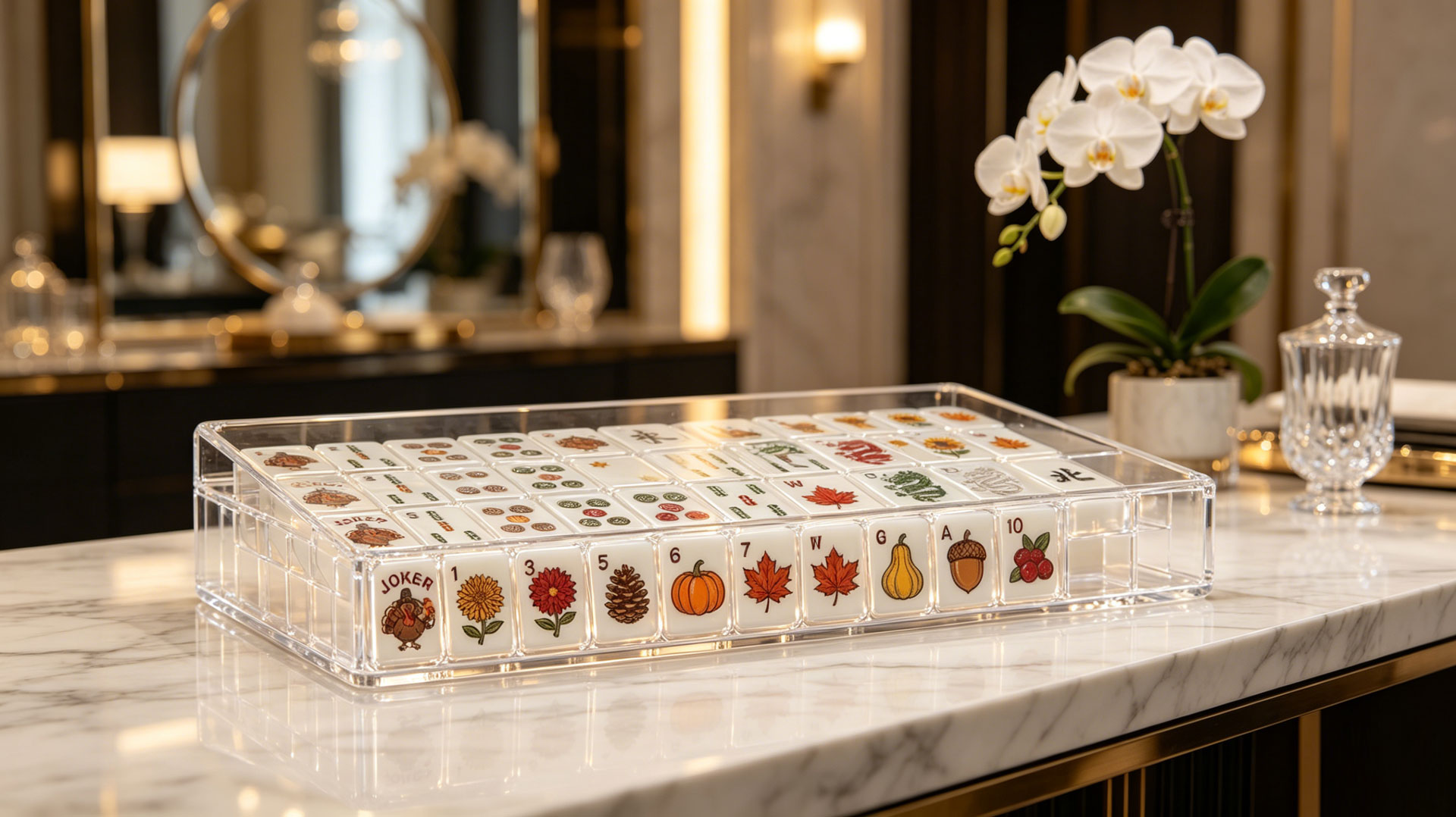
A single color shift between production runs can make two mahjong tiles from the same set look like they came from different manufacturers. In bulk custom American mahjong tiles production, quality control is not a final inspection — it is a continuous process embedded at every stage from raw material receipt to final packaging.
This article traces the QC checkpoints that separate consistent, shipment-ready tile sets from batches that require rework or rejection: incoming material testing, in-process sampling, color-difference management, defect classification, and full-batch uniformity assurance.
Key Points:
• Raw acrylic is tested for transparency, density, and surface defects before any cutting begins — substandard material is rejected at the dock
• In-process inspection occurs at five production stages with defined sampling rates and acceptance criteria
• Color consistency is maintained within ΔE ≤ 2.0 using spectrophotometer verification at the sheet and tile levels
• Defects are classified into three tiers with specific disposition rules — not all defects require scrapping
• Full-batch uniformity is verified through a final 100% inspection that checks every tile against the approved sample
Why Quality Control in Mahjong Tile Production Is Different
Mahjong tiles present a QC challenge that most acrylic products do not: every tile in a 152-piece set must look like it belongs in the same set. A display stand with a minor surface blemish ships as a single unit. A mahjong tile with a color shift from its neighbor is immediately visible on the table and unacceptable to the end user. This is not a theoretical concern — it is the most common quality complaint in bulk tile orders, and it cannot be fixed by simply replacing the outlier tile if the replacement does not match the rest of the set.
This requirement — set-level consistency rather than piece-level acceptability — means that conventional pass/fail inspection at the end of the line is insufficient. A batch where 98% of tiles pass individually can still fail as a set if the 2% that pass at the margins create visible variation. Effective QC in mahjong tile production must verify both individual tile quality and batch-wide uniformity.
The inspection framework described below reflects ISO 9001-certified procedures applied at JAYI's facility, where 100% outgoing inspection and third-party inspection support are standard for all custom mahjong set orders.
Incoming Material Inspection — Before Production Begins
What Gets Tested
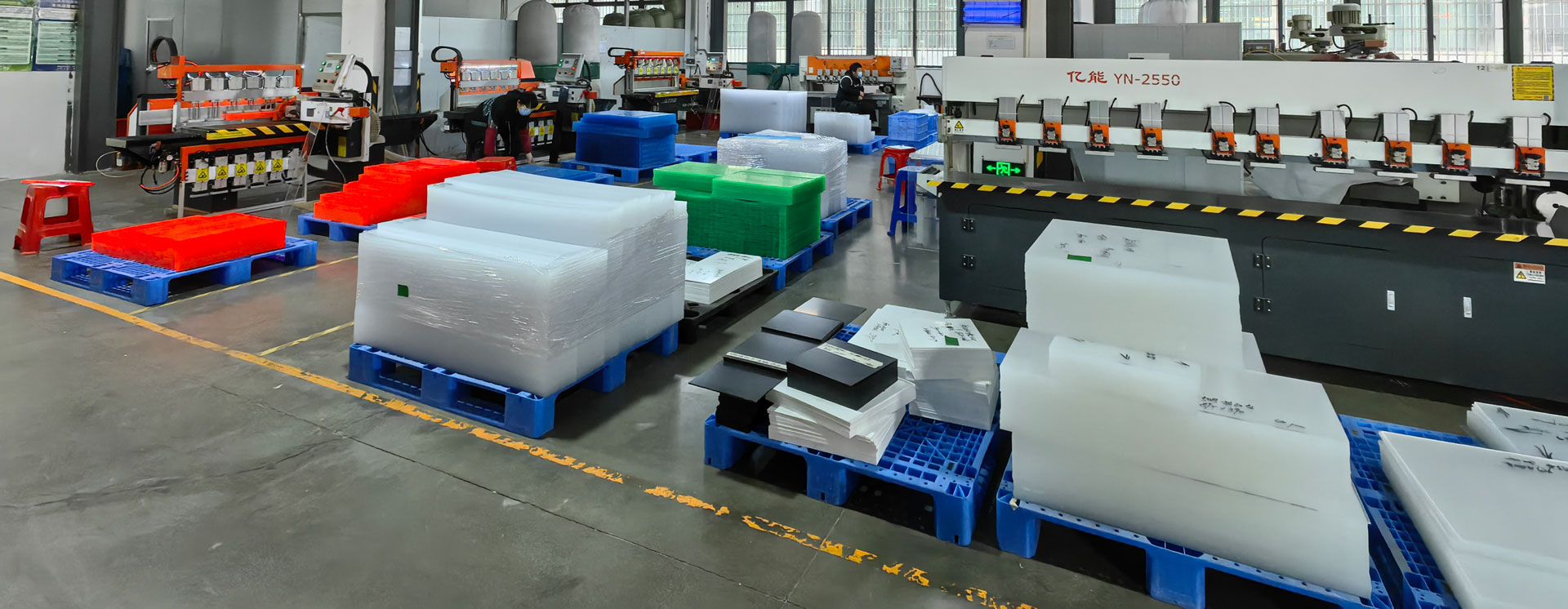
Raw acrylic sheet is the foundation of every tile. Defects in the substrate cannot be corrected downstream — a sheet with internal bubbles produces tiles with internal bubbles, regardless of how precisely the CNC machine cuts them.
| Test | Method | Acceptance Criterion | Rejection Consequence |
|---|---|---|---|
| Transparency | Spectrophotometer at 550nm | ≥ 92% transmittance (clear acrylic) | Sheet rejected; replacement ordered |
| Density | Precision scale (±0.01g) + volume measurement | Within ±1% of specification | Sheet rejected |
| Surface defects | Visual inspection under LED panel (1000 lux) | No scratches, bubbles, or inclusions >0.3mm | Sheet rejected if defects exceed limit |
| Color consistency | Spectrophotometer vs. Pantone reference | ΔE ≤ 1.5 at sheet level | Sheet quarantined for re-measurement |
| Thickness uniformity | Digital micrometer at 5 points per sheet | ±0.15mm across sheet | Sheet rejected |
Material Traceability
Every acrylic sheet entering the facility is tagged with a lot number that links to the supplier, production date, and test results. If a quality issue surfaces during production, the lot number enables trace-back to the specific material batch — and forward to every tile cut from that sheet.
Material rejection rates are tracked monthly. Sheets that fail incoming inspection are returned to the supplier with a detailed defect report. A rejection rate exceeding 3% triggers a supplier review. JAYI's policy of using 100% virgin acrylic — never recycled material — is enforced at this stage: recycled sheets exhibit inconsistent density and lower transparency that are detectable in the density and transparency tests above.
In-Process Inspection at Five Production Stages
Quality checkpoints are embedded at each stage of the production workflow. Each checkpoint has defined sampling rates, acceptance criteria, and escalation procedures.
Stage-by-Stage QC Matrix
| Stage | Process | Inspection Point | Sampling Rate | Key Criteria |
|---|---|---|---|---|
| 1. Cutting | CNC cutting of acrylic sheet | Dimensional accuracy of blank tiles | 10% per batch | ±0.1mm vs. spec |
| 2. Engraving | Laser engraving of tile face | Engraving depth, edge sharpness, path accuracy | 15% per batch | Depth ±0.05mm; no burrs |
| 3. Printing | UV printing or screen printing | Color registration, ink adhesion, alignment | 15% per batch | Registration ±0.2mm; ΔE ≤ 2.0 |
| 4. Polishing | Diamond polishing of edges | Surface finish, chip-free edges | 10% per batch | No visible chips; Ra ≤ 0.8μm |
| 5. Assembly & Packaging | Tile set assembly, insert packaging | Completeness, tile sequence, packaging integrity | 100% | All 152 tiles present; no damage |
Escalation Rules
When an in-process inspection reveals a defect rate exceeding the acceptable threshold, production on that batch is paused. The QC team isolates the affected tiles, identifies the root cause, and implements corrective action before resuming. Common root causes and their corrections include:
| Defect Pattern | Likely Root Cause | Corrective Action |
|---|---|---|
| Systematic dimensional drift | CNC tool wear | Tool replacement; recalibration |
| Engraving depth variation | Laser power fluctuation | Laser calibration; power stabilization |
| Print registration offset | Fixture misalignment | Fixture re-alignment; re-zeroing |
| Edge chipping on polish | Polishing wheel condition | Wheel replacement; feed rate adjustment |
Color Consistency Management Across the Batch
The ΔE Standard
Color difference is measured in ΔE (Delta E) units — a standardized metric representing the perceptual distance between two colors. A ΔE of 1.0 is the threshold of perceptibility: most people cannot distinguish a color difference below 1.0 under normal viewing conditions. For custom American mahjong set production, the standard is maintained at ΔE ≤ 2.0, with ΔE ≤ 1.5 available for brands with strict color fidelity requirements.
Where Color Variation Enters
| Production Variable | How It Affects Color | Control Method |
|---|---|---|
| Acrylic sheet batch | Different production lots of the raw sheet can carry a slight tint variation | Match sheet lot to order; measure ΔE at incoming inspection |
| Ink formulation | UV ink batches can shift if mixing ratios vary | Batch-level ink verification; viscosity and color measurement |
| Cure conditions | UV lamp intensity and exposure time affect the final ink color | Lamp intensity monitoring; timed exposure control |
| Substrate interaction | Ink color shifts on tinted acrylic vs. white reference | Always proof on the actual acrylic color, not on paper |
| Engraving depth | Deeper engraving changes the light refraction in the cut channel | Depth verification at engraving stage (see Stage 2 above) |
Color Verification Workflow
1. Pre-production: Pantone reference converted to CMYK; test print on actual acrylic substrate; spectrophotometer reading recorded as baseline
2. Sheet-level: Every acrylic sheet is measured against the baseline before cutting begins
3. Tile-level: First tile off each CNC/engraving/printing run measured against baseline
4. Batch-level: 10% of finished tiles measured spectrophotometrically; if any tile exceeds ΔE 2.0, the entire batch is measured
This multi-layer verification catches color drift at the earliest possible stage — when correction costs are lowest. A color shift caught at the sheet level requires only a sheet swap; the same shift caught at the finished-tile level requires scrapping and re-running all affected tiles. The principle is straightforward: the later a color problem is detected, the more material, labor, and time have already been invested in the affected tiles — and the higher the cost of correction.
Defect Classification and Disposition
Not all defects are equal. A three-tier classification system determines the disposition of each defective tile — whether it is reworked, downgraded, or scrapped.
Defect Tiers
| Tier | Definition | Examples | Disposition |
|---|---|---|---|
| Critical | Defect that renders the tile unusable or unsafe | Cracked tile; missing engraving; wrong symbol | Scrap — never rework |
| Major | Defect visible at arm's length that affects appearance or function | Color shift ΔE > 2.0; deep scratch; misaligned print | Rework if possible; otherwise scrap |
| Minor | Defect visible only on close inspection; does not affect function | Light surface mark ≤0.5mm; slight polish variation | Accept or rework at client's discretion |
Defect Rate Thresholds
| Order Size | Critical (max) | Major (max) | Minor (max) |
|---|---|---|---|
| ≤ 500 sets | 0% | 1.5% | 3.0% |
| 501–2,000 sets | 0% | 1.0% | 2.5% |
| > 2,000 sets | 0% | 0.8% | 2.0% |
Critical defects have zero tolerance at any volume. Major and minor defect rates decrease as order volume increases — larger runs provide more statistical control and should yield tighter quality distribution.
What Happens to Defective Tiles
Tiles classified as scrap are destroyed and recycled through the acrylic regrind process (regrind material is used for non-product applications, never for tile production).
Tiles classified as reworkable return to the appropriate production stage — re-polishing for edge defects, re-printing for color issues, re-engraving for depth errors.
Reworked tiles are re-inspected at the same sampling rate as first-pass tiles before they re-enter the production flow.
Defect Reporting to Clients
When defects are discovered during 100% outgoing inspection, clients receive a defect report that includes the defect type, quantity, root cause analysis, and corrective action taken.
For major and critical defects, the report also includes photographic evidence and the disposition decision (rework or scrap).
Transparency at this stage builds confidence in the production process — even when defects occur, documented corrective action demonstrates process control rather than reactive problem-solving.
Full-Batch Uniformity — The Final 100% Inspection
Why 100% Inspection Is Necessary for Mahjong
Sampling-based QC works for products where individual units are sold independently. Mahjong sets are sold as complete units — a single outlier tile compromises the entire set. For this reason, the final inspection for mahjong tile sets is 100%: every tile is checked, not a statistical sample.
100% Inspection Checklist
| Check | Method | Pass Criterion |
|---|---|---|
| Tile count | Manual count against 152-tile manifest | Exact count match |
| Symbol accuracy | Visual comparison to approved artwork | Correct symbol on every tile |
| Color uniformity | Visual comparison to approved sample under D65 light | No visible color difference from sample |
| Dimensional accuracy | Digital caliper measurement of length, width, thickness | ±0.1mm vs. spec |
| Surface quality | Visual inspection under LED panel | No critical or major defects |
| Engraving/print quality | Visual and tactile inspection | Clean edges; no fill-in; correct depth |
| Set completeness | Verification against tile map (4 Craks × 4 suits, etc.) | All ranks and suits present |
Third-Party Inspection
For brands requiring independent verification, JAYI Acrylic supports third-party inspection at the factory before shipment.
Inspectors from SGS, TUV, or client-designated agencies can access the production floor and inspection records. The ISO 9001 quality management system documentation is available for auditor review, and the 100% outgoing inspection records provide the data trail that third-party inspectors verify against.
The same 100% inspection standard applies to accessory items: acrylic mahjong racks included in a set order undergo the same dimensional and surface quality checks as the tiles themselves.
The quality infrastructure — including ISO 9001, SGS, TUV, BSCI, and SEDEX certifications — reflects a facility-level commitment to process discipline, not just product inspection.
These certifications are audited annually and require documented corrective-action procedures for every nonconformance.
For brands sourcing acrylic board game products at volume, this certification stack provides the compliance baseline that major retailers require before onboarding a supplier.
FAQ
What quality standards apply to custom American mahjong tile production?
ISO 9001 is the baseline quality management standard, governing documented procedures, corrective action, and continuous improvement. At the product level, dimensional tolerance (±0.1mm), color consistency (ΔE ≤ 2.0), and 100% outgoing inspection are the primary standards. Additional certifications such as SGS, TUV, BSCI, and SEDEX address supply chain compliance requirements from major retailers.
How is color consistency verified across a bulk production run?
Color is measured at three levels using a spectrophotometer: raw acrylic sheet before cutting, the first tile off each production run, and 10% of finished tiles. If any tile exceeds ΔE 2.0 from the approved baseline, the entire batch is measured. The approved sample from the pre-production stage serves as the color reference throughout the run.
What happens when a defective mahjong tile is found during 100% inspection?
The mahjong tile is classified as critical, major, or minor. Critical defects (cracks, missing symbols) result in scrapping with no rework. Major defects (visible color shift, deep scratches) are reworked if possible or scrapped. Minor defects (barely visible surface marks) may be accepted or reworked at the client's discretion. Replacement tiles are produced and re-inspected before inclusion in the set.
Can I request third-party inspection before shipment?
Yes. On-site inspection by SGS, TUV, or client-designated third-party agencies is supported at the factory. The production floor, inspection records, and quality documentation are accessible to authorized inspectors. Third-party inspection is recommended for first orders and for brands supplying major retail chains that require independent quality verification.
How does raw material quality affect the final tile product?
Raw acrylic quality determines the ceiling of what the final product can achieve. Sheets with internal bubbles produce tiles with bubbles. Sheets with inconsistent density produce tiles that polish unevenly. Sheets with color variation produce tiles that cannot match within ΔE 2.0. This is why incoming material inspection — transparency, density, surface, color, and thickness — happens before any cutting, and substandard sheets are rejected at the dock.
What defect rate should I expect in a bulk order?
Critical defects are held at 0%. Major defect rates are limited to 0.8–1.5% depending on order volume (tighter rates for larger orders). Minor defect rates are limited to 2.0–3.0%. These thresholds are documented in the quality agreement and verified at the 100% outgoing inspection. Any set containing a critical or major defect tile is corrected before shipment.
Conclusion
Vetting American mahjong tile suppliers is a systematic, multi-dimensional evaluation rather than a simple price comparison.
Buyers must prioritize valid certifications, stable dedicated production capacity, full-process QC with 100% final inspection, verified OEM export track records, flexible cooperation terms, and reliable after-sales support.
Adhering to this standardized vetting framework helps wholesale and retail buyers eliminate unqualified manufacturers, avoid quality risks and delivery delays, and establish long-term, stable, and compliant supply chain partnerships for US market sales.

Cathy Qin
Cathy Qin works at Jayi Acrylic Industry Limited, focusing on custom acrylic game product management and SEO-driven content marketing for B2B wholesale and retail applications. Her work includes designing display solutions, managing customization projects, and optimizing website content to promote Jayi’s high-quality acrylic products across global digital channels.
Post time: Jun-10-2026