
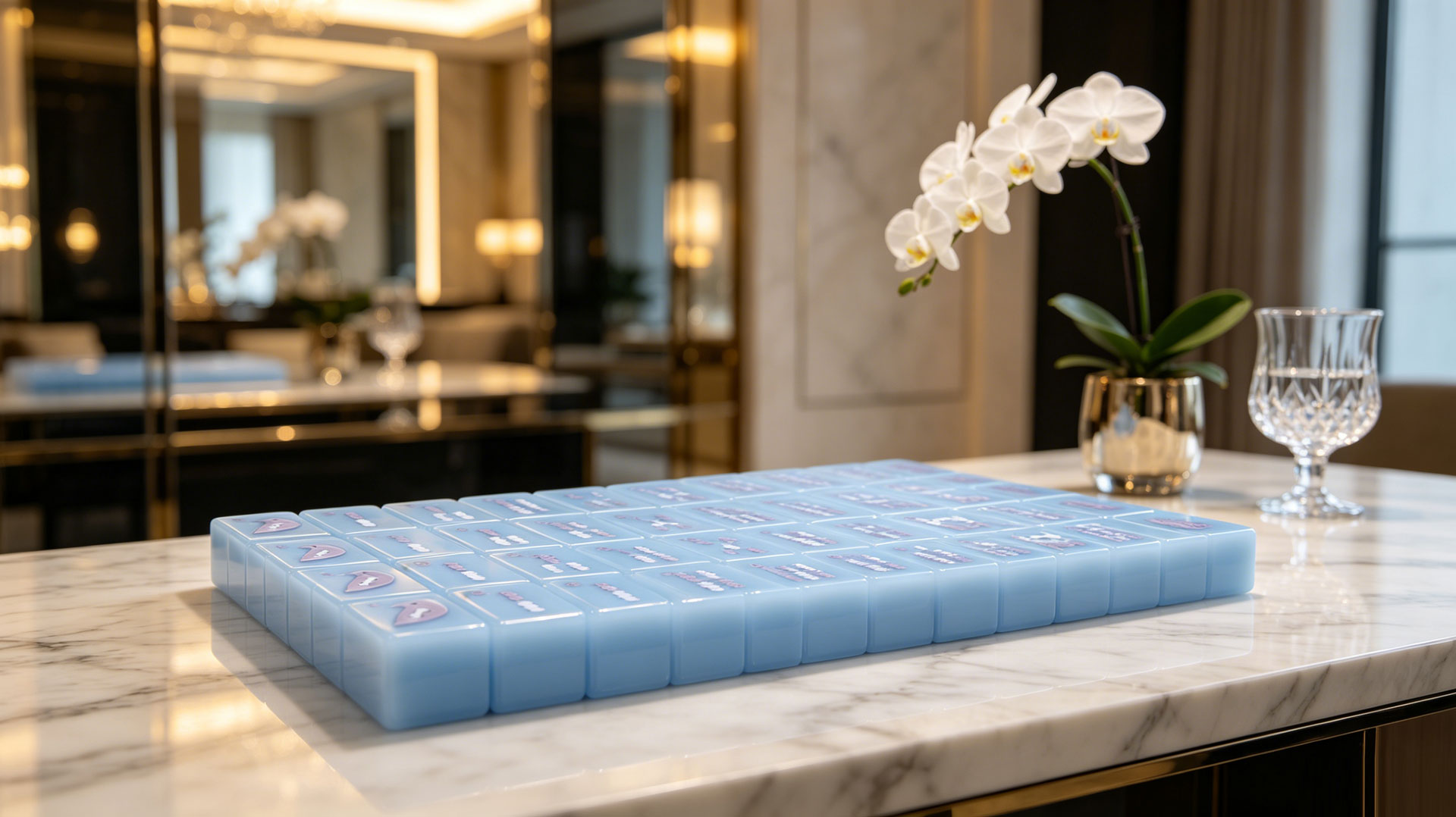
Brands entering the American mahjong market face a foundational decision: bring your own finished design to a factory for production (OEM), or partner with a manufacturer who develops the product from concept to shelf (ODM). The choice affects lead time, development cost, design ownership, and how much of the production process you control. This article maps both models against the specific requirements of mahjong tile production — mold tooling, Pantone color matching, tile face engraving, and printing — so you can decide which path fits your brand strategy and budget.
Key Points:
• OEM suits brands with finalized designs who need a factory to execute; ODM suits brands entering mahjong for the first time who want a turnkey product
• OEM requires you to supply production-ready files and specifications; ODM shifts design responsibility to the factory
• Both models follow the same sampling and approval workflow — the difference is who creates the design
• NDA signing precedes any design discussion; tooling and mold ownership depend on the contract terms
• JAYI supports both models with 22 years of acrylic OEM/ODM experience across Walmart, Target, and Sam's Club supply chains
OEM and ODM — Definitions and How They Differ in Acrylic Mahjong Production
OEM (Original Equipment Manufacturing): A production model where the brand supplies complete design specifications — acrylic mahjong tile dimensions, artwork files, color codes, packaging artwork — and the factory manufactures exactly to those specs. The brand owns all intellectual property; the factory contributes manufacturing capability only.
ODM (Original Design Manufacturing): A production model where the factory develops the product design based on the brand's market brief — target price point, aesthetic direction, demographic — and presents finished design proposals for the brand to select and refine. The factory contributes both design and manufacturing; IP ownership is negotiated in the contract.
In the context of American mahjong tiles, the practical difference comes down to who creates the tile face artwork, selects the color palette, defines the tile dimensions, and designs the packaging. Under OEM, you deliver all of these. Under ODM, the factory's product development team delivers them for your approval.
| Dimension | OEM | ODM |
|---|---|---|
| Design source | Brand supplies finished artwork | The factory develops from the brand brief |
| Brand involvement | High — every spec defined by the brand | Medium — brand approves and refines proposals |
| Development cost | Lower (no factory design fees) | Higher (includes factory design labor) |
| Time to sample | Faster if files are production-ready | Longer — includes design iteration cycle |
| IP ownership | Brand retains full IP | Negotiable — depends on contract |
| Best for | Brands with in-house design teams | Brands new to mahjong or lacking design resources |
The OEM Workflow — From Your Design to Finished Mahjong Tiles
Step 1: Specification Submission
You provide a complete specification package that includes:
• Tile dimensions and profile (e.g., 35 × 25 × 14mm, rounded corners R2)
• Tile face artwork in production-ready format (vector AI/EPS for engraving, 300+ DPI raster for UV print — see our design file specs guide for format requirements)
• Pantone color codes for tile body and all printed/engraved elements
• Packaging artwork and structural layout
• Quantity per SKU and total order volume
The factory's engineering team reviews the package for production feasibility. Incomplete specifications are returned with a detailed gap list — not a generic rejection. Most complete packages are reviewed in 1 business day.
Step 2: Pre-Production Sampling
Once specifications pass review, the factory produces a physical sample. For OEM orders, the sample confirms that the factory's interpretation of your specs matches your intent. You evaluate:
• Tile body color accuracy against Pantone reference
• Engraving depth and edge crispness
• Print registration and color fidelity
• Overall dimensional accuracy
• Packaging fit and finish
Sample production takes 25–30 days, depending on complexity. Shipping time varies by destination.
Step 3: Approval and Bulk Production
After you approve the sample, tooling is locked and bulk production begins.
The approved sample serves as the quality benchmark — every tile in the production run is measured against it. Any deviation from the approved sample triggers a hold and correction before shipment.
The same sampling-and-approval process applies to acrylic mahjong racks if your order includes accessory items alongside the tile set.
OEM production runs follow the standard 15–35 day manufacturing window, with 100% quality inspection before shipment and support for third-party inspection at the factory.
The ODM Workflow — From Market Brief to Original Product
Step 1: Market Brief and Direction
You provide a market brief that defines your commercial requirements without specifying product details:
• Target price point and margin requirements
• Target demographic and aesthetic direction (e.g., "modern minimalist for 25–40 age group" or "traditional Chinese aesthetic for cultural retail")
• Competitive positioning — what distinguishes your product on the shelf
• Volume expectations for initial order and projected annual volume
The factory's product development team translates this brief into a design proposal. This is where ODM adds the most value: the factory applies its category knowledge to make design decisions that balance aesthetics, manufacturability, and cost.
Step 2: Design Proposal and Iteration
The factory presents 2–3 design directions, each including:
• Tile face artwork concepts for all 152 tiles (Craks, Bams, Dots, Winds, Dragons, Flowers, Jokers)
• Tile body color and finish options with Pantone references
• Packaging design concepts
• Cost estimates based on the proposed specifications
You select a direction and request refinements. The iteration cycle typically takes 1–2 rounds before the design is finalized. Each round requires 5–7 business days.
Step 3: Sampling and Approval
Once the design is finalized, the factory produces a physical sample using the same process and quality standards as OEM. You evaluate the sample against the design proposal and approve or request final adjustments. After approval, production proceeds identically to the OEM path.
The total ODM timeline from brief to sample approval is typically 3–5 weeks longer than OEM, accounting for the design development phase. For brands entering the custom American mahjong set market for the first time, this additional time is offset by not needing to build in-house mahjong design expertise.
Mold Tooling — Ownership, Cost, and Reuse
Who Owns the Mold?
Mold ownership is one of the most commercially significant terms in any OEM or ODM agreement. In mahjong tile production, molds define the tile profile — the exact shape, thickness, corner radius, and any embossed features on the tile body. Without the mold, no tile can be produced.
| Scenario | Mold Ownership | Implications |
|---|---|---|
| Brand pays the tooling fee separately | The brand owns the mold | A brand can transfer mold to another factory; a factory cannot use it for other clients |
| Tooling cost absorbed into unit price | The factory owns the mold | Brand is locked to this factory; the factory may offer the same profile to other clients |
| Exclusive mold with amortized tooling | The factory owns, but has an exclusive-use agreement | A brand cannot transfer, but a factory cannot sell the same profile elsewhere |
For OEM orders where the brand supplies unique tile profiles, exclusive mold ownership is standard. For ODM orders using the factory's existing tile profiles, the mold is factory-owned and shared across clients — your differentiation comes from tile face artwork and color, not from the tile shape.
Tooling Cost Factors
| Factor | Cost Impact |
|---|---|
| Standard tile profile (from factory library) | No tooling fee |
| Modified standard profile (minor dimension change) | Low tooling fee |
| Custom tile profile (unique shape or embossing) | Full tooling investment |
| Custom packaging insert mold | Separate tooling fee |
Tooling fees are quoted per project based on profile complexity. Standard profiles for popular American mahjong tile sizes are available with no tooling charge — the cost is absorbed into the unit price. Custom profiles require dedicated tooling, which is quoted upfront before any production commitment.
Intellectual Property Protection and Confidentiality
NDA First, Discussion Second
No design file, artwork concept, or market brief should be shared before a signed NDA is in place. The NDA defines:
• What information is confidential (design files, pricing, volume data, market strategy)
• How the factory may use confidential information (manufacturing for your brand only)
• Duration of confidentiality obligations (typically 3–5 years post-termination)
• Remedies for breach
JAYI signs NDAs as standard practice. For brands with their own NDA templates, the legal team reviews and executes within 3–5 business days. For brands without an NDA, a mutual confidentiality agreement template is available.
Design IP in OEM vs ODM
When visiting or commissioning a third-party audit of an American mahjong tile manufacturer, verify these items:
| IP Concern | OEM | ODM |
|---|---|---|
| Tile face artwork | Brand owns — supplied by brand | Negotiable — factory creates, contract specifies ownership |
| Tile body profile | Brand owns if the custom tooling is paid for | The factory owns if using the standard library |
| Packaging design | Brand owns — supplied by brand | Negotiable — depends on who created it |
| Color palette | Brand specifies — brand owns | Factory proposes — ownership per contract |
For ODM projects, the contract must explicitly state who owns the tile face artwork and packaging design after the project concludes. Without this clause, the factory may retain the right to reuse design elements with other clients.
Protecting Your Brand Assets
Beyond the NDA, practical measures to protect your IP include:
• Watermark all design previews shared during the proposal stage before contract execution
• Register trademarks for brand names and logos before sharing them with any factory
• Document the design timeline — dated sketches, revision histories, and approval records establish creation provenance
• Specify IP clauses in the purchase contract — not just the NDA, but the commercial agreement that governs the production relationship
When to Choose OEM vs ODM — Decision Framework
Decision Matrix
| Your Brand Situation | Recommended Model | Why |
|---|---|---|
| In-house design team with mahjong experience | OEM | You already control the creative output; OEM maximizes your design investment |
| Brand with design capability but no mahjong experience | ODM with design collaboration | Factory fills category knowledge gaps; you retain creative direction |
| Brand new to tabletop games entirely | ODM | The factory provides turnkey product development |
| Established mahjong brand expanding into acrylic | OEM | Existing designs transfer to new material with minor adaptation |
| Distributor seeking private-label product | ODM | Fastest path to a market-ready product under your brand name |
| Brand with strong IP and design patents | OEM | Maximum control over design execution and IP boundaries |
Cost Comparison
Cost structure differs between models. OEM shifts design cost to the brand but eliminates factory design fees. ODM includes factory design fees but removes the need for in-house design resources. Over multiple production runs, the per-unit cost difference narrows as design fees are amortized.
| Cost Element | OEM | ODM |
|---|---|---|
| Design development | Brand bears internally | Factory fee (one-time or amortized) |
| Tooling (custom profile) | Brand pays if needed | Same — tooling is project-specific |
| Sampling | Standard sample cost | May include multiple sample rounds |
| Unit price | Lower (no design amortization) | Slightly higher (includes design recovery) |
| Total first-order cost | Depends on the brand's internal design cost | More predictable — factory quotes all-in |
JAYI Acrylic Factory operates a 10,000㎡ facility with 150+ workers and 95+ sets of production equipment, running full in-house processes from raw acrylic cutting through CNC engraving, diamond polishing, screen printing, and packaging.
This vertical integration means both OEM and ODM projects move through a single production chain without outsourcing gaps — which is why retailers like Walmart and Target have approved JAYI as a qualified supplier for acrylic board game products, including custom mahjong set lines.
FAQ

What is the difference between OEM and ODM for mahjong tiles?
OEM (Original Equipment Manufacturing) means the brand supplies complete design specifications, and the factory manufactures to those specs. ODM (Original Design Manufacturing) means the factory develops the product design based on the brand's market brief, and the brand approves or refines the proposal. The core difference is who creates the design: the brand (OEM) or the factory (ODM).
Can I start with ODM and switch to OEM for future orders?
Yes. Many brands begin with ODM to enter the market quickly, then transition to OEM as they build in-house design capability. Once you own the approved artwork and specifications from the ODM process, you can supply those same files as OEM inputs for subsequent orders — provided your contract grants you ownership of the design IP developed during the ODM engagement.
Who owns the mahjong tile face artwork in an ODM project?
Ownership depends on the contract. Without an explicit IP clause, the factory may retain rights to reuse design elements. Standard ODM contracts include a transfer-of-ownership clause that assigns the tile face artwork IP to the brand upon full payment, but brands should always verify this provision before signing.
How long does the ODM design development phase take?
The ODM design phase typically adds 3–5 weeks to the overall timeline compared to OEM. This includes the initial design proposal (1–2 weeks), 1–2 rounds of iteration (1–2 weeks), and sample production (25–30 days). The total time from initial brief to approved sample is generally 5–7 weeks.
Do I need to sign an NDA before sharing my design files?
Yes. No design files, artwork, or market strategy should be shared before a signed NDA is in place. The NDA protects both parties and establishes clear boundaries for how confidential information may be used. Standard NDA execution takes 3–5 business days from either party's template.
Can I use a standard mahjong tile profile and still differentiate my product?
Absolutely. Most American mahjong brands differentiate through tile face artwork, color palette, and packaging design rather than tile body shape. Standard profiles eliminate tooling fees and reduce lead time, while unique artwork and color choices create a product that is visually distinct on the shelf. For brands needing a proprietary tile shape, custom tooling is available at an additional cost.
Conclusion
OEM and ODM are two flexible, reliable customization modes for custom American mahjong tile production, catering to different brand development stages and resource conditions.
OEM delivers faster sampling, lower unit costs, and full IP ownership for brands with mature design solutions, while ODM provides turnkey design, development, and production services for new market entrants lacking professional design capabilities.
With clear mold ownership rules, complete IP protection measures, and strict quality control, both cooperation modes can help brands launch competitive, high-quality custom mahjong products for the US market.

Cathy Qin
Cathy Qin works at Jayi Acrylic Industry Limited, focusing on custom acrylic game product management and SEO-driven content marketing for B2B wholesale and retail applications. Her work includes designing display solutions, managing customization projects, and optimizing website content to promote Jayi’s high-quality acrylic products across global digital channels.
Post time: Jun-08-2026