
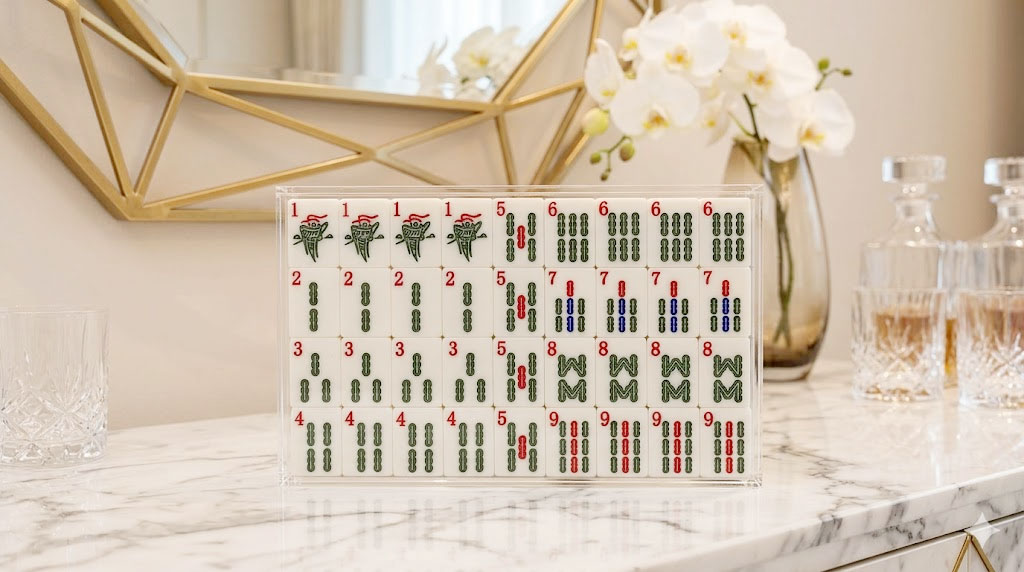
Launching a private label mahjong program puts your brand on a product with deep cultural relevance and growing commercial demand. But the gap between "I want my own mahjong line" and holding a finished, shelf-ready set is wider than most brand owners expect. This guide covers every decision point — from what you can customize to how production actually works — so you can move from concept to launch with clarity instead of guesswork.
Key Points:
• Private label mahjong gives you brand equity on a proven product category with lower development risk than creating a new game from scratch
• Customization spans tile body, face artwork, printing method, color system, packaging, and accessories
• The production workflow follows a structured path: brief → sampling → approval → mass production → QC → shipment
• MOQ, lead time, and cost depend on customization depth and order volume — understanding the structure helps you plan budgets accurately
• Selecting a factory with integrated production (cutting, polishing, printing, and packaging under one roof) reduces lead times and quality drift
Why Brand Owners Choose Private Label Mahjong
Private label programs let you sell a product that carries your brand identity without developing the underlying product from scratch. In the mahjong category, this matters because the product itself is already validated — players know the game, retailers know it sells, and the supply chain is mature. Your job is not to invent a new game; it is to make a mahjong set that looks, feels, and performs in a way that reflects your brand standards.
For brands already selling wholesale mahjong sets or board games, private-label mahjong creates a natural extension. You control the visual identity, the unboxing experience, and the price positioning — while JAYI Acrylic handles the engineering, material sourcing, and production logistics.
The strategic advantage is speed. A brand entering mahjong through private label can move from initial brief to first shipment in 8–12 weeks, compared to 6+ months for a fully original product development cycle. That shorter timeline reduces cash flow exposure and lets you test market response before committing to larger volumes.
What You Can Customize in a Private Label Mahjong Program
Customization in private label mahjong operates on three layers:
• Tile-level
• Accessory-level
• Packaging-level
Each layer contributes to the final brand experience, and you control how deep you go at each stage.
Tile-Level Customization
The mahjong tile is where most brand owners focus first — it is the component customers touch, shuffle, and remember. Customization options include:
| Customization Element | Options | Production Consideration |
|---|---|---|
| Tile body color | Solid colors, translucent, marble-effect, gradient | Pantone-matched; translucent bodies require virgin acrylic for clarity |
| Tile dimensions | Standard 35×25×14mm or custom profiles | Non-standard sizes may require new mold tooling |
| Face artwork | Custom patterns, brand logos, themed illustrations | Vector files (AI/EPS) for engraving; 300+ DPI raster for UV print |
| Printing method | Laser engraving, screen printing (up to 8 colors), UV digital print, hot stamping | Each method suits different artwork complexity and volume |
| Edge finish | Diamond-polished, frosted, chamfered | Polished edges give a premium feel; frosted reduces fingerprint visibility |
When you source custom mahjong tiles, the printing method you choose affects both unit cost and minimum order quantity. Laser engraving works well for simpler designs at lower volumes; screen printing delivers the best per-unit economics at scale; UV digital printing handles complex artwork without plate costs but has a higher per-unit price.
Accessory-Level Customization
Accessories complete the set and provide additional branding surfaces:
1. Mahjong racks
Our premium acrylic mahjong racks are fully customizable to fit your unique demands. You can select tailored lengths to match different tile sizes, and add brand logos or patterns via precise laser engraving. We also support professional Pantone color matching, so the rack tone stays consistent with your mahjong tiles. These functional racks serve as great branding carriers to elevate your full set’s premium look and unified brand style.
2. Mahjong mat
Our high-quality mahjong mats are ideal supporting accessories to complete your full mahjong set. We offer comprehensive customization, including custom sizes, exclusive colors, and full-color printing. You can print brand logos, themed patterns, or brand slogans on the surface to strengthen your brand image. Made of neoprene, a wear-resistant material, the mat reduces tile sliding noise and protects both tiles and table surfaces. It is a practical and decorative addition for retail sales, gifts, and branded private label mahjong collections.
3. Dice and wind indicators
We provide fully customizable mahjong dice and wind indicators to complement your branded sets. You can pick your preferred solid or gradient colors and apply fine laser engravings for logos, icons, or exclusive patterns. Every detail can be adjusted to align with your brand design. These small but essential accessories help form a complete branded experience and make your private label mahjong more distinctive on the market.
4. Carrying case
We offer two main styles of mahjong carrying cases: sturdy hard-shell and lightweight soft-shell options. We can customize the internal compartment layout to perfectly hold tiles, racks, and other accessories. Meanwhile, the exterior can be painted with your brand’s exclusive colors, logos, and prints. Well-designed cases not only ensure safe storage and transport but also leave a deep branded impression on end customers.
5. Scorekeeping tools
Our customizable scorekeeping tools include printed scorecards and durable acrylic score trackers. We support full-color custom printing to add your brand logo, slogans, or themed artwork on the surface. Made with quality materials, these tools are practical for daily gameplay. They enrich the complete mahjong set, polish every branding detail, and bring a more thoughtful, high-end experience to players.
Packaging-Level Customization
Packaging is the first thing your customer sees and the last thing they remember. Private label programs typically customize:
1. Retail box structure and dimensions
We fully customize retail box structures and overall dimensions to match your complete mahjong set and market positioning. Whether you need compact boxes for travel sets or rigid gift boxes for premium collections, we adjust sizes, shapes, and internal partitions accordingly. Tailored box designs not only fit all accessories perfectly but also create a unique shelf look to attract customers and highlight your private label advantages.
2. Exterior and interior printing (full-color, Pantone, or foil stamping)
We support diverse printing solutions for box interiors and exteriors, including vivid full-color printing, accurate Pantone color matching, and luxury foil stamping. These professional finishing techniques present your brand logos, patterns, and brand colors perfectly. From daily retail styles to high-end decorative effects, multiple printing options help your packaging stand out and deliver a premium branded visual experience.
3. Instruction booklet with brand voice and visual identity
We design and produce custom instruction booklets that fully follow your brand tone and visual standards. Apart from clear gameplay guidance, we add your brand logos, exclusive color schemes, and unified graphic styles on every page. These booklets are more than usage guides; they extend your brand image, build brand recognition among users, and form a cohesive brand experience for your private label mahjong products.
4. Insert cards, tissue paper, and other unboxing elements
We provide customized insert cards, printed tissue paper, and a full range of unboxing accessories to upgrade the whole unboxing journey. You can print brand information, slogans, or decorative patterns on these small items. Delicate unboxing details reflect your brand’s attention to quality, leave a deep impression on buyers, and differentiate your private label mahjong sets from ordinary products in the market.
The Private Label Mahjong Production Process
Understanding the production workflow helps you set realistic timelines and avoid bottlenecks. Here is how a typical private label mahjong project moves from concept to shipment at our facility.
Step 1: Project Brief and NDA
You share your product concept — target market, visual direction, price point, and volume expectations. We sign a mutual NDA before any design discussion begins. This protects your intellectual property and gives you confidence to share brand assets freely.
Step 2: Design Development and Specification
Based on your brief, we develop a product specification that covers tile dimensions, color palette, artwork placement, accessory list, and packaging structure. If you have in-house design capability (OEM model), you provide production-ready files, and we review them for manufacturability. If you need design support (ODM model), our product development team creates design proposals for your selection and refinement — for a detailed comparison of both approaches, see our OEM vs ODM guide for American mahjong tiles.
Step 3: Sampling
We produce physical samples within 25–30 business days of specification approval. You evaluate the sample for color accuracy, tactile feel, artwork fidelity, and packaging quality. Most projects require 1–2 rounds of revision before sample approval — this is normal and built into the timeline.
Step 4: Mass Production
Once you approve the sample, production begins. Our facility processes orders through an integrated workflow — cutting, CNC carving, diamond polishing, bonding, printing, and packaging all happen in-house. For game products, our annual output exceeds 300,000 units, supported by a 10,000-square-foot㎡ production floor and 95+ sets of specialized equipment. This vertical integration means fewer handoffs, tighter quality control, and shorter lead times compared to factories that outsource printing or packaging steps.
Step 5: Quality Control and Shipment
Every set undergoes 100% inspection before shipment — visual check for surface defects, dimensional check against approved specs, and functional check for packaging integrity. Third-party inspection is welcome at any stage. Production lead time runs 80–90 days, depending on order complexity and volume.
MOQ, Lead Times, and Cost Structure
Private label programs have different cost dynamics than stock product purchasing. Understanding the structure helps you plan accurately.
| Cost Component | Typical Range | Notes |
|---|---|---|
| Mold/tooling fee | Varies by complexity | One-time cost; may be waived at higher volumes |
| Sample fee | Nominal | Often credited against the production order |
| Unit price | Based on specs and volume | Includes tile production, printing, and assembly |
| Packaging cost | Based on the box structure | Custom rigid boxes cost more than standard cartons |
| Shipping | FOB, CIF, or DDP | Depends on destination and incoterm |
Minimum order quantities for private-label mahjong sets typically start at 300 sets, depending on customization depth and printing method. Higher MOQs unlock better per-unit pricing because setup costs amortize across more units.
Typical timeline:
| Phase | Duration |
|---|---|
| Brief and NDA | 1-hour |
| Design and specification | 1–days |
| Sampling and revision | 20–30 days |
| Mass production | 80–90 days |
| QC and shipment prep | 3–5 days |
| Total (first order) | 104–125 days |
Reorders move faster — because tooling and artwork are already approved.
How to Evaluate a Private Label Mahjong Partner
Choosing the wrong factory/supplier costs more than a bad sample — it costs lost launch windows, inconsistent quality, and compromised brand reputation. Use this checklist when evaluating potential partners.
Private Label Partner Evaluation Checklist
• Integrated production: Does the factory cut, polish, print, and package in-house, or does it outsource key steps? Integrated facilities offer tighter quality control and shorter lead times.
• Material transparency: Does the factory use 100% virgin acrylic, or does it blend recycled material? Virgin acrylic delivers 95% light transmittance and consistent color — recycled material introduces cloudiness and batch variation.
• Certification depth: Does the factory hold ISO 9001, SGS, BSCI, and SEDEX certifications? These indicate process discipline and social compliance — essential if you sell through major retailers.
• Retailer audit history: Has the factory passed audits from national or global retailers? Audit experience means the factory understands documentation, traceability, and compliance requirements at the level your brand may need.
• Sampling speed: Can the factory deliver samples within one week? Slow sampling delays decisions and extends your time-to-market.
• IP protection practices: Does the factory sign NDAs proactively? Does it separate design files and restrict access to your brand assets?
• Communication quality: Does your contact respond within one business day with substantive answers — not just "we can do it"?
• Reference accounts: Can the factory share case studies or client references from similar private label programs?
Manufacturing Capabilities Behind Your Private Label Program
Your private label program is only as reliable as the factory producing it. At JAYI, our manufacturing infrastructure is designed to support brand owners who need consistency, traceability, and scale.
Our 10,000㎡ square foot facility in Boluo County, Huizhou, processes acrylic through a full in-house chain: raw sheet cutting → CNC precision carving (±0.1mm tolerance) → diamond-edge polishing → bonding → screen printing / laser engraving / UV digital printing → assembly and packaging. Each step operates under ISO 9001 process controls, and every production lot is traceable from raw material to finished carton.
For specific American mahjong set production, this matters because tile quality depends on processing precision. A tile body that deviates 0.3mm in thickness feels different in the hand and stacks unevenly during play. Our CNC carving maintains dimensional accuracy within ±0.1mm, and our diamond polishing produces edges that are smooth to the touch — no micro-burrs, no visible tool marks.
We produce acrylic board game products at volumes exceeding 300,000 units annually, with our broader JAYI manufacturing operation generating RMB 70 million in annual output. This scale means we can accommodate both initial test orders and high-volume replenishment without quality drift. Our facility has passed supplier audits from Walmart and Target — a credential that reflects not just product quality but the documentation and compliance infrastructure your private label program may require for retail distribution.
All acrylic raw material is 100% virgin resin (no recycled content), delivering 95% light transmittance and consistent color density across production batches. For brand owners, this means the tile color you approve in sampling is the tile color you receive in mass production — batch after batch.
FAQ
What is the minimum order quantity for private label mahjong sets?
Minimum order quantities for private-label mahjong sets typically start at 300 sets, depending on the level of customization and the printing method selected. Higher volumes unlock better per-unit pricing as tooling and setup costs amortize across more units.
How long does it take to produce a private label mahjong order?
First-time private label orders generally take 80–90 days from initial brief to shipment, including design development, sampling with revision, mass production, and QC. Reordering is faster because tools and artwork are already established.
Can I use my own artwork for the tile faces?
Yes. You can supply production-ready artwork files — vector files (AI/EPS) for laser engraving and screen printing, or high-resolution raster files (300+ DPI) for UV digital printing. Our engineering team reviews all files for production feasibility before sampling begins.
What printing method works best for private label mahjong tiles?
The best printing method depends on your artwork complexity and order volume. Laser engraving suits simple logos and text at lower volumes; screen printing (up to 8 colors) delivers the best economics for medium-to-high volumes; UV digital printing handles complex, multi-color artwork without plate setup costs.
Do I own the mold and tooling for my private label design?
Mold and tooling ownership depends on your contract terms. In most OEM arrangements, the brand pays for tooling and retains ownership. In ODM arrangements, ownership is negotiated. We discuss tooling terms transparently during the specification phase so there are no surprises.
How does a private label program differ from buying stock products?
Private label programs give you full control over the product's visual identity, specifications, and packaging — the product carries your brand, not the factory's. Stock products are pre-manufactured with fixed specifications and limited or no customization. Private label requires higher MOQs and longer lead times but delivers a product that is exclusively yours.
Conclusion
Private label mahjong is a low-risk, high-reward product extension for modern brand owners, enabling exclusive branded products with proven market demand.
Choosing an integrated, certified manufacturer is critical to ensuring consistent quality, flexible customization, and on-time delivery.
As a professional private label mahjong supplier with 22 years of experience, in-house full-process production, and global retail audit qualifications, JAYI Acrylic delivers reliable OEM/ODM solutions for brands of all sizes.
Partner with us to launch your premium private label mahjong line and stand out in the competitive tabletop game market.

Cathy Qin
Cathy Qin works at Jayi Acrylic Industry Limited, focusing on custom acrylic game product management and SEO-driven content marketing for B2B wholesale and retail applications. Her work includes designing display solutions, managing customization projects, and optimizing website content to promote Jayi’s high-quality acrylic products across global digital channels.
Post time: Jun-15-2026